Ethea
Auf Deutsch lesen Coming soon

Conflict Resolution

Staying in the room when you disagree

Usually hardest for: Emotionality high, Agreeableness low

The three phases

  1. Day 1–7

    Notice

    Watch it happen. Nobody else has to know.

  2. Day 8–14

    Try it small

    Do it where it costs you nothing.

  3. Day 15–28

    For real

    The people and rooms that actually matter.

Three of the 28 days

One from each phase, in full. The rest arrive one a day in the app — the first 7 days free.

Day 1 about 10 min

Count every disagreement you have today

Open a note on your phone and tally every disagreement you have today — spoken or silent. The eye-roll at a headline counts, the meeting comment you swallowed counts, the argument in the group chat counts. At the end of the day, write down the total and where most of them happened. Nobody needs to know you're doing it.

Why it matters

Most people think conflict is rare in their life, so they never prepare for it. Seeing the real number shows how many chances to practice an ordinary day hands you for free.

If it stalls

Set two phone reminders — midday and evening — so the tally doesn't die by lunch. If you reach the evening with an empty list, the silent ones slipped past you: count every time you thought "that's wrong" and said nothing.

Afterwards you answer

  • How many did you count, and how many did anyone else actually notice?
  • Where did most of them happen — work, home, online?
  • How many did you keep completely to yourself?
Day 8 about 5 min

Politely correct one small thing today

Today, when something small isn't right with a stranger involved — wrong change, a wrong order, a cold dish — say so in one calm sentence: "Sorry, I ordered the small one." No pile of apologies, no glare, just the sentence. If you usually come on strong, your version is the opposite: say it once, friendly, then let them fix it without supervising.

Why it matters

A one-sentence correction to a stranger is the smallest possible dose of real friction: the stakes are almost nil and you'll never see them again. It teaches your voice that disagreeing can be calm and quick.

If it stalls

One sentence, a smile, then stop talking — the pause after is part of it. If nothing goes wrong all day, make a small ask instead: a seat swap, the sauce on the side, a different table.

Afterwards you answer

  • What did you correct, and what did they actually do?
  • How long did the discomfort last — honestly?
Day 15 about 10 min

Raise a small thing while it's small

Pick one small recurring thing that quietly bugs you about someone you live or work with — the dishes, the thermostat, the meeting that always overruns, the doc nobody updates. Tell them today, in two sentences: what keeps happening, and what you'd like instead. Say it in a calm moment, while it's still a small thing — not mid-annoyance.


Why it matters

Small things that never get said don't stay small; they turn into the third argument about something else. Raising it at size one is ten times easier than at size ten.

If it stalls

Open with the size: "Tiny thing, ten seconds." If they get defensive, you don't have to win today — "I just wanted to say it out loud" is a complete ending.

Afterwards you answer

  • How did they react, next to what you feared?
  • How long had you been carrying this one?

How progress is measured

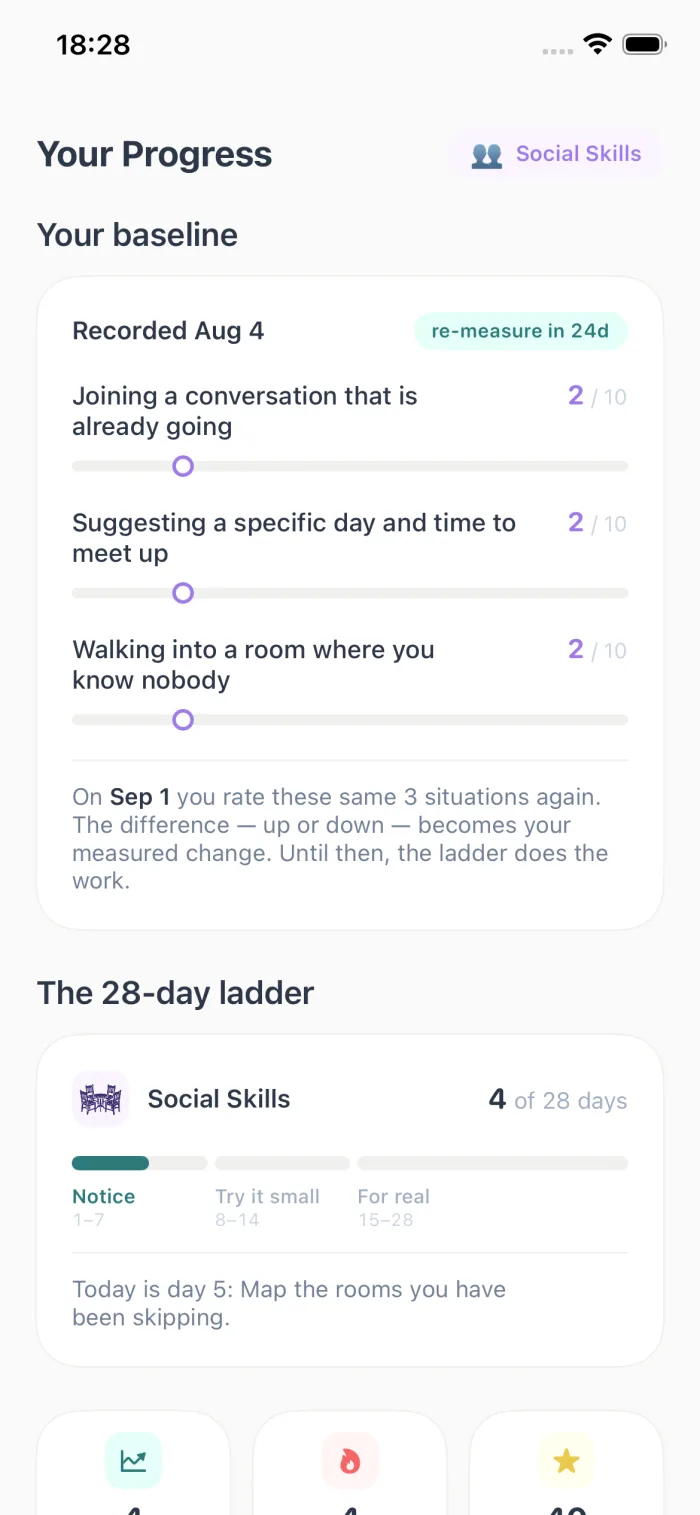
Before you start you rate these situations from 1 to 5. After 28 days you rate them again, without ever seeing the first answers. The difference is the whole point of the app.

  • Disagreeing with someone more senior than you
  • Raising a problem before it turns into an argument
  • Staying calm when someone criticizes your work
Conflict Resolution

Find out where you actually stand.

Five minutes for the assessment. 7 days free after that.

Coming to the App Store

iPhone · iOS 17 or later