Ethea
Auf Deutsch lesen Coming soon

Social Skills

Getting into rooms and conversations you would otherwise skip

Usually hardest for: Extraversion low

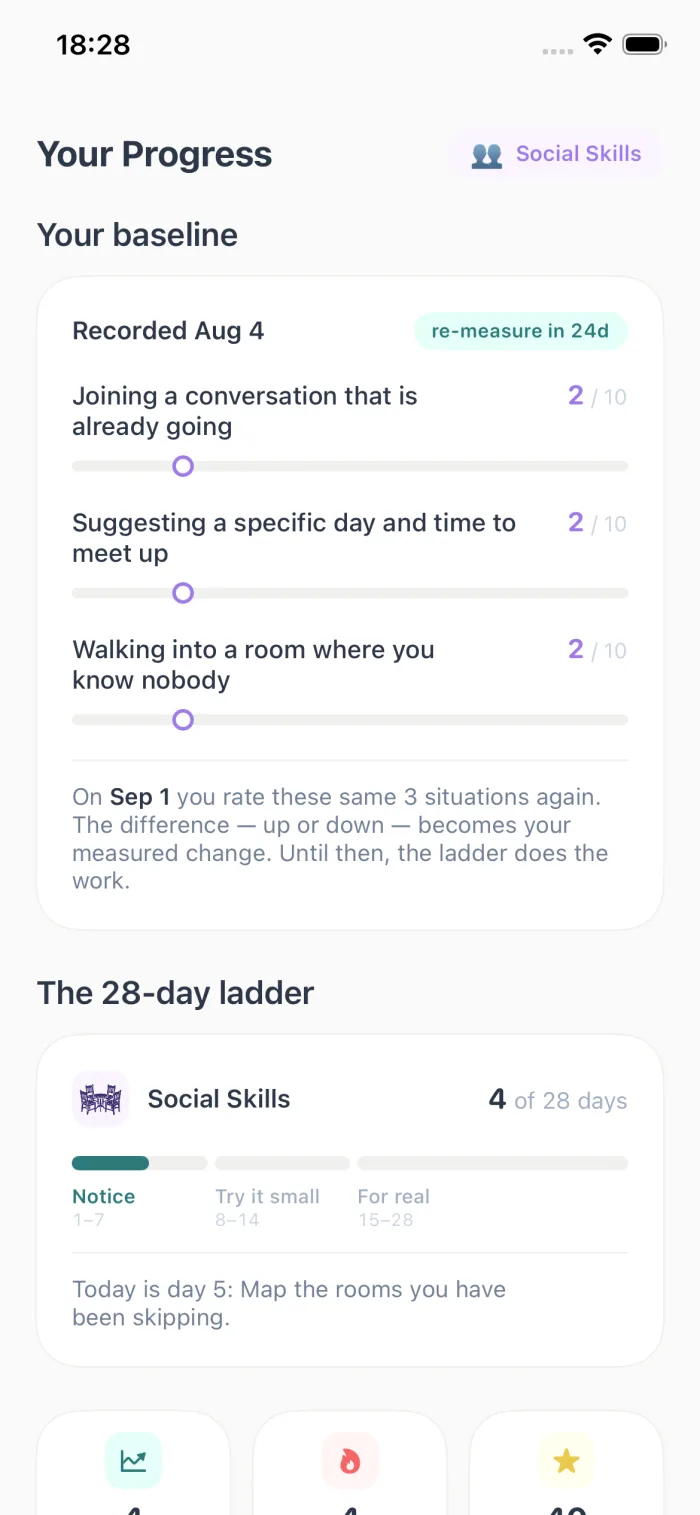
The three phases

  1. Day 1–7

    Notice

    Watch it happen. Nobody else has to know.

  2. Day 8–14

    Try it small

    Do it where it costs you nothing.

  3. Day 15–28

    For real

    The people and rooms that actually matter.

Three of the 28 days

One from each phase, in full. The rest arrive one a day in the app — the first 7 days free.

Day 1 about 10 min

Count the openings you let pass

Keep a running tally today of every moment you could have said something to someone and chose not to — the lift, the queue, the kitchen at work, the neighbor at the door. Do not change anything yet; just count. In the evening, write the final number down.

Why it matters

You cannot get into more rooms until you can see the doors, and most people have no idea how many they walk past in a single day.

If it stalls

Use your phone's notes app, or count on your fingers and jot the number down at lunch. A moment counts even if speaking would have been slightly odd — you are counting chances, not obligations.

Afterwards you answer

  • What was your final count — higher or lower than you would have guessed?
  • Which one moment do you most wish you had taken?
  • Where did most of your openings show up — work, errands, home?
Day 8 about 10 min

Greet three people on your usual route

Greet three people you pass anyway today — the neighbor at the bins, the person at the bus stop, the receptionist, the dog walker. Eye contact, a nod and a clear "good morning" is the whole job. Count them off: one, two, three.

Why it matters

A greeting is the smallest possible door into a conversation, and a door you have opened once opens far more easily the next time.

If it stalls

Attach each greeting to a fixed spot on your route so you do not have to decide in the moment. If someone does not respond, yours still counts — you were only ever responsible for your half.

Afterwards you answer

  • How did each of the three respond?
  • Which greeting was hardest to start, and why that one?
  • Did anyone react anything like the worst case you had imagined?
Day 15 about 10 min

Speak first three times today

Three times today, with people you actually know — colleagues, neighbors, the regulars at the gym — be the one who speaks first, before they decide whether to. Go one sentence past hello each time: a name, plus a question or a comment on the thing you are both looking at. Count to three; do not stop at one.


Why it matters

With people you keep seeing, whoever speaks first quietly sets the tone of the whole relationship — and going first is a role you can simply take.

If it stalls

Names are amplifiers: "Morning, Dana — how was the match?" lands twice as warmly as "Morning". The lift, the kitchen and the corridor are your three easiest venues.

Afterwards you answer

  • Where did your three happen?
  • Did anyone seem surprised — pleasantly or otherwise?
  • Which of the three could turn into a longer conversation this week?

How progress is measured

Before you start you rate these situations from 1 to 5. After 28 days you rate them again, without ever seeing the first answers. The difference is the whole point of the app.

  • Joining a conversation that is already going
  • Suggesting a specific day and time to meet up
  • Walking into a room where you know nobody
Social Skills

Find out where you actually stand.

Five minutes for the assessment. 7 days free after that.

Coming to the App Store

iPhone · iOS 17 or later