Ethea
Auf Deutsch lesen Coming soon

Vulnerability

Letting someone see the part you would rather hide

Usually hardest for: Emotionality low, Honesty-Humility low

The three phases

  1. Day 1–7

    Notice

    Watch it happen. Nobody else has to know.

  2. Day 8–14

    Try it small

    Do it where it costs you nothing.

  3. Day 15–28

    For real

    The people and rooms that actually matter.

Three of the 28 days

One from each phase, in full. The rest arrive one a day in the app — the first 7 days free.

Day 1 about 10 min

Tally every "I'm fine" you say today

All day today, keep a tally on your phone: add one every time someone asks how you are and you answer "fine", "good", or "busy" when the real answer was something else. Don't change anything yet — just count. Before bed, write the final number down.

Why it matters

You can't loosen a habit you haven't seen. Most people are startled by how often the shutter comes down without them deciding anything.

If it stalls

A notes-app tally or a rubber band moved from wrist to wrist both work. Autopilot answers to strangers count too.

Afterwards you answer

  • What was your final number?
  • Which answer was furthest from the truth?
  • Who got the most honest version of you today?
Day 8 about 5 min

Give one real answer to "How are you?"

Once today, when someone low-stakes asks how you are — the barista, the cashier, a colleague you barely know — skip "fine" and give one true sentence: "Honestly, a bit tired. Long week." Then let the conversation go wherever it goes.

Why it matters

One honest sentence to a near-stranger teaches you what the list alone can't: you can be seen slightly un-fine and the room stays standing.

If it stalls

One sentence, kept light — tired, slow morning, glad it's Friday. You're not opening up to the barista; you're just not performing.

Afterwards you answer

  • What did you say, and to whom?
  • How did they respond?
  • How long did the nerves last afterwards?
Day 15 about 10 min

Ask the "too basic" question in a group

In today's meeting, class, or group chat, ask the question you'd normally swallow for being too basic: "Sorry — what does that abbreviation stand for?" "Can someone recap what we decided?" Ask it in front of everyone, not in a private message afterwards.


Why it matters

In any group, half the room is stuck on the same thing and grateful someone said it. The asker trades thirty seconds of looking slow for being the person who moved things forward.

If it stalls

Earlier is easier — every minute you wait, "I should know this by now" grows. No meetings today? A family or friends group chat counts.

Afterwards you answer

  • What did you ask, and who was there?
  • What happened in the ten seconds after?
  • Was anyone else visibly relieved?

How progress is measured

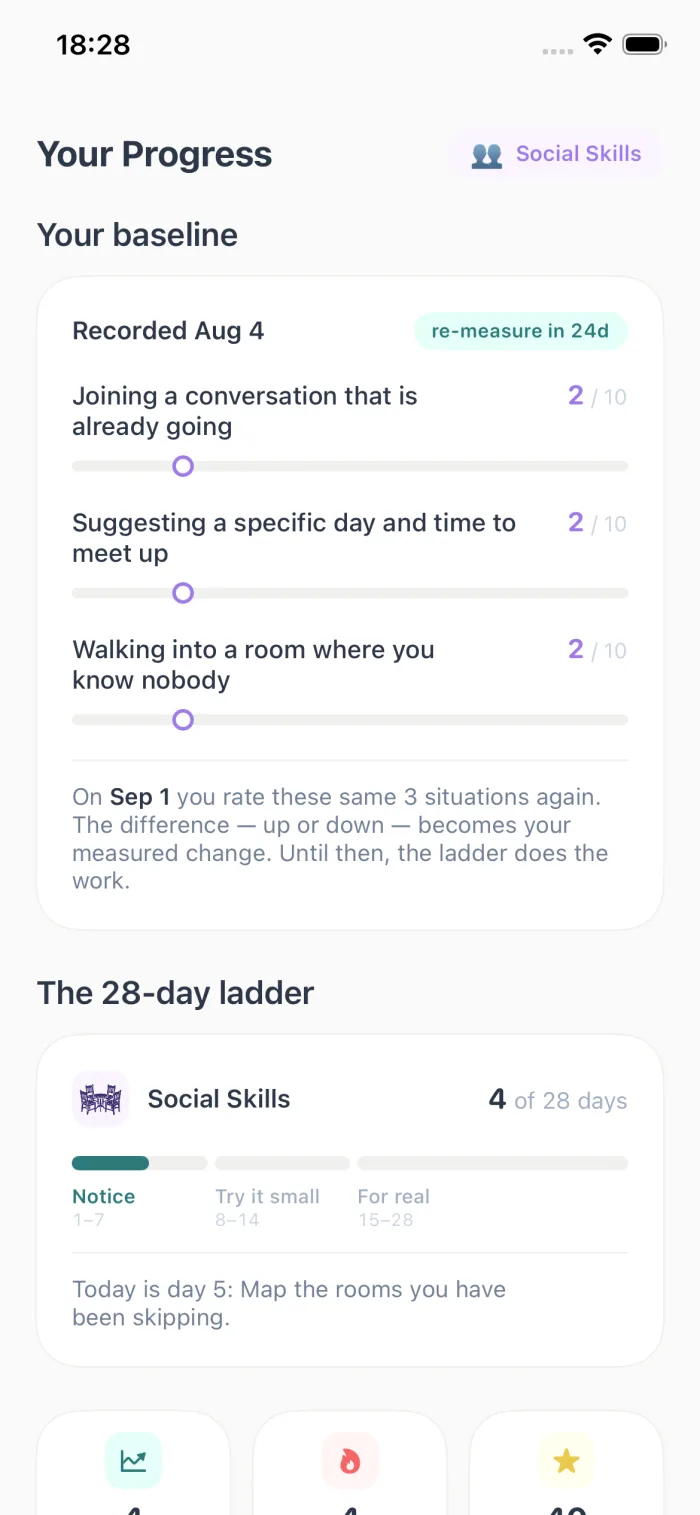
Before you start you rate these situations from 1 to 5. After 28 days you rate them again, without ever seeing the first answers. The difference is the whole point of the app.

  • Asking someone for help when you are stuck
  • Admitting a mistake without softening it
  • Telling a friend you are having a hard time
Vulnerability

Find out where you actually stand.

Five minutes for the assessment. 7 days free after that.

Coming to the App Store

iPhone · iOS 17 or later